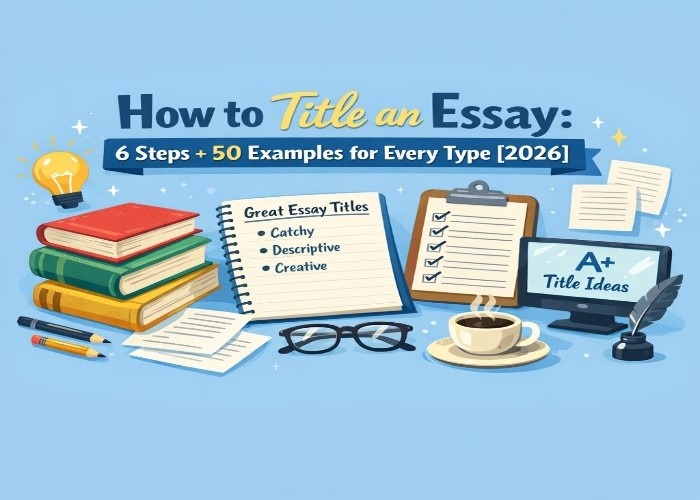
The Role of Essay Titles in Academic Writing
Titles determine how your work is perceived before anyone reads it.
Think about browsing article headlines online. Which do you click? The specific, intriguing titles or the generic, vague ones?
Professors make the same snap judgments with student essays. Your title signals:
- Quality: Specific titles suggest careful thinking; vague titles suggest rushed work
- Focus: Clear titles show you understand your topic; unclear titles suggest confusion
- Professionalism: Properly formatted titles demonstrate attention to detail
A strong essay title accomplishes four critical objectives:
- Captures attention: Makes readers want to read further
- Conveys content: Clearly indicates your essay's topic and scope
- Establishes tone: Sets appropriate expectations (academic vs. creative)
- Distinguishes your work: Separates your essay from generic alternatives
Example comparison:
Weak: "Social Media Essay"
Strong: "How Instagram Algorithms Amplify Teenage Anxiety"
The strong title specifies the platform, identifies the mechanism, and names the outcome. Readers know exactly what to expect.
Struggling to Create the Perfect Essay Title?
Let experts craft titles that grab attention and meet academic standards
- Get compelling, topic-focused essay titles written by professionals
- Ensure alignment with your thesis and assignment guidelines
- Improve clarity, relevance, and first impressions
- Save time and avoid weak or misleading titles
A strong title sets the tone, trust our essay writing service to get it right from the start.
Order NowThe 6 Step Process for Creating Strong Titles
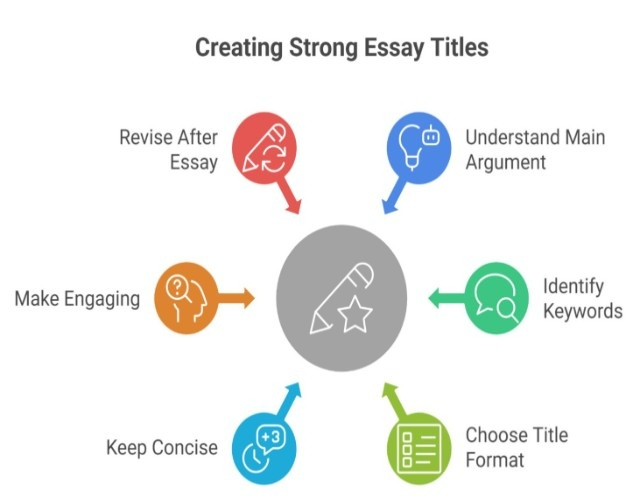
Step 1: Understand Your Essay's Main Argument
You can't title what you don't fully understand.
Before crafting your title, clearly identify your essay's central point. What are you actually arguing or explaining?
How to identify your main point
|
Example: If your essay argues that remote work increases productivity through reduced commutes and fewer interruptions, your title should reflect this specific argument, not just "Remote Work Essay."
Step 2: Identify Key Topic Keywords
Include searchable terms readers might look for.
List the essential nouns and concepts central to your discussion. These keywords help readers (and search engines) understand your topic.
Example for a climate change essay
Your title should incorporate 2 to 3 of these keywords naturally. |
Step 3: Choose Your Title Format
Five proven structures work for most essays:
Format 1: Declarative Statement: Makes a clear claim
"Remote Work Increases Productivity Through Elimination of Commute Time"
Format 2: Question: Provokes thought
"Does Social Media Improve or Damage Teenage Mental Health?"
Format 3: How-To Formula: For instructional content
"How Renewable Energy Can Replace Fossil Fuels by 2050"
Format 4: Colon Structure: Main topic: specific focus
"Artificial Intelligence: Why Current Regulation Fails to Address Algorithmic Bias"
Format 5: Surprising Contrast: Challenges assumptions
"Why Exercise Makes You More Creative: The Science Behind Movement and Innovation"
Select the format that best matches your essay type and content.
Step 4: Keep It Concise and Specific
Strong titles use 5 to 12 words.
Avoid unnecessary articles, prepositions, and filler words that dilute impact.
- Wordy (18 words): "An Examination of the Various Ways in Which Technology Has Changed Modern Education."
- Concise (8 words): "How Digital Tools Transform Modern Classroom Learning."
- Guidelines: Remove "a," "an," "the" when possible, Cut phrases like "an analysis of" or "a study on", Use active verbs, Be specific, not general.
Step 5: Make It Engaging
Generic titles blend in. Specific titles stand out.
1. Generic: "The Internet and Society"
2. Engaging: "How TikTok's Algorithm Shapes Gen Z Political Beliefs"
Techniques for engagement
|
Step 6: Revise After Completing Your Essay
Write a working title for direction, but finalize it after drafting.
As you write, your argument evolves. Your final title should accurately reflect what you actually wrote, not what you planned to write.
Revision checklist
|
50 Title Examples by Essay Type
Argumentative Essays (10 examples)
- "Why College Should Be Free for All U.S. Citizens".
- "The Case for Mandatory Voting in Democratic Elections".
- "Social Media Platforms Must Be Regulated as Publishers".
- "Why the Death Penalty Fails Both Morally and Practically".
- "Remote Work Increases Productivity More Than Office Based Employment".
- "Why Animal Testing Should Be Banned Worldwide".
- "College Athletes Deserve Payment for University Revenue Generation".
- "The Four-Day Workweek Improves Productivity and Employee Wellbeing".
- "Why Cryptocurrency Cannot Replace Traditional Currency".
- "School Start Times Should Begin at 9 AM for Teenage Health".
Analytical Essays (10 examples)
- "How Symbolism Drives the Plot in The Great Gatsby".
- "The Role of Foreshadowing in Romeo and Juliet's Tragedy".
- "How Orwell Uses Language to Demonstrate Power in 1984".
- "Analyzing Gender Dynamics in Pride and Prejudice".
- "The Function of the Chorus in Greek Tragedy".
- "How Setting Shapes Character Development in Wuthering Heights".
- "Metaphor and Meaning in Robert Frost's 'The Road Not Taken'".
- "The Significance of the Green Light in The Great Gatsby".
- "How Fitzgerald Critiques the American Dream Through Symbolism".
- "Examining Narrative Perspective in To Kill a Mockingbird".
Expository Essays (10 examples)
- "How Photosynthesis Converts Light Energy Into Chemical Energy"
- "The Three Branches of U.S. Government Explained"
- "How the Electoral College Determines Presidential Elections"
- "The Process of Fossil Fuel Formation Over Millions of Years"
- "How Vaccines Train the Immune System to Fight Disease"
- "The Water Cycle: From Evaporation to Precipitation"
- "How Supply and Demand Determine Market Prices"
- "The Stages of Mitosis in Cell Division"
- "How Credit Scores Are Calculated and Why They Matter"
- "The Nitrogen Cycle's Role in Ecosystem Sustainability"
Narrative/Personal Essays (10 examples)
- "The Summer I Failed My Driver's Test Three Times"
- "How Losing the Championship Game Taught Me About Resilience"
- "The Day I Realized My Grandmother's Stories Were History"
- "Finding My Voice Through Failed Auditions"
- "The Conversation That Changed My Career Path"
- "How Moving to a New Country Redefined 'Home' for Me"
- "The Moment I Understood What Courage Actually Means"
- "Why Failing Chemistry Became My Best Learning Experience"
- "The Day I Stopped Trying to Please Everyone"
- "How Volunteering at a Homeless Shelter Changed My Perspective"
Compare and Contrast Essays (10 examples)
- "Public vs. Private School: Which Provides Better Education?"
- "Online Learning vs. Traditional Classrooms: Effectiveness Compared"
- "Capitalism and Socialism: Economic Systems Contrasted"
- "Living in Cities vs. Suburbs: Quality of Life Comparison"
- "Renewable Energy vs. Fossil Fuels: Long-Term Cost Analysis"
- "Democratic vs. Republican Economic Policies: Real-World Impacts"
- "iOS vs. Android: Which Operating System Serves Users Better?"
- "Traditional vs. Alternative Medicine: Efficacy and Safety Compared"
- "Book vs. Movie Adaptations: Why Reading Usually Wins"
- "Working from Home vs. Office: Productivity and Satisfaction Compared".
Make Your Essay Stand Out From the First Line
Professional essay help that starts with the perfect title
- Customized titles tailored to your subject and academic level
- SEO and professor friendly wording
- Clear, concise, and engaging title structures
- Support for essays, research papers, and assignments
Don’t let a weak title undermine your work, our essay writing experts are here to help.
Order NowTitle Formatting Rules by Citation Style
1. MLA Format Title Rules
Capitalization
- Capitalize first and last words
- Capitalize all major words (nouns, pronouns, verbs, adjectives, adverbs)
- Don't capitalize articles (a, an, the), coordinating conjunctions (and, but, or), or prepositions unless first/last word
Formatting
- Center title on first page
- Use standard capitalization (no bold, no underline)
- Italicize book/journal titles: The Great Gatsby
- Use quotation marks for articles/essays: "The Impact of Climate Change."
Example MLA title: "How Social Media Algorithms Influence Political Beliefs"
2. APA Format Title Rules
Capitalization
- Capitalize the first word of the title and subtitle
- Capitalize all proper nouns
- Don't capitalize other words
Formatting
- Place on separate title page
- Center and bold
- Italicize book titles: The Psychology of Influence
- No quotation marks for article titles
Example APA title: "The effects of remote work on employee productivity and satisfaction"
3. Chicago Style Title Rules
Capitalization
- Capitalize first and last words
- Capitalize all nouns, pronouns, verbs, adjectives, and adverbs
- Don't capitalize articles, conjunctions, or prepositions unless the first/last word
Formatting
- Italicize book titles: To Kill a Mockingbird
- Use quotation marks for article titles: "The Effects of Social Media".
- Center title
Example Chicago title: "The Role of Technology in Modern Healthcare Delivery"
Learn more about proper formatting in our essay format guide.
Need help with more than just titles? Our professional essay writing service crafts complete essays with compelling titles, strong thesis statements, and evidence based arguments that earn top grades.
Common Title Mistakes to Avoid
Mistake #1: Being Too Broad
Problem: Title could apply to hundreds of essays
Bad: "Technology and Society"
Good: "How Smartphone Addiction Affects Face-to-Face Communication Skills"
Fix: Add specific platforms, mechanisms, or outcomes.
Mistake #2: Using Vague Language
Problem: Unclear what essay actually discusses
Bad: "Some Thoughts on Education"
Good: "Why Project-Based Learning Produces Better Student Outcomes Than Lectures"
Fix: Replace vague words (things, stuff, some, many) with specific terms.
Mistake #3: Making Titles Too Long
Problem: Titles exceeding 15 words become unwieldy
Bad: "An In-Depth Analysis and Examination of the Various Ways in Which Social Media Platforms Have Changed How Teenagers Communicate"
Good: "How Social Media Changed Teenage Communication Patterns"
Fix: Cut unnecessary phrases. Be direct
Mistake #4: Titling Before Writing
Problem: Final essay doesn't match preliminary title
Fix: Use working titles during drafting, but create the final title after completing your essay. This ensures your title accurately reflects what you actually wrote.
Mistake #5: Unnecessary Question Marks
Problem: Questions that aren't actually questions
Bad: "The Impact of Climate Change?"
Good: "How Climate Change Threatens Coastal Communities"
Fix: Only use question marks for actual questions. Otherwise, use declarative statements.
Turn a Good Essay Into a Great One With the Right Title
Expert guidance for titles that reflect strong academic writing
- Thoughtfully crafted titles that match your argument
- Compliance with MLA, APA, or Chicago style expectations
- Enhanced readability and academic credibility
- Quick, reliable support from experienced writers
Start strong and finish confident, choose our essay writing service for titles that make an impact.
Order NowBottom Line
Strong essay titles grab attention while accurately representing your content. Follow the 6-step process: understand your main argument, identify keywords, choose a format, keep it concise, make it engaging, and revise after completing your draft.
The best titles are specific rather than generic. "How Instagram Algorithms Amplify Teenage Anxiety" beats "Social Media Essay" because it names the specific platform, mechanism, and outcome. Specific titles signal quality thinking.
Keep titles between 5 to 12 words. Remove unnecessary articles and filler phrases. Use active verbs and concrete nouns. Make every word earn its place.
Format titles correctly for your citation style. MLA capitalizes major words, APA uses sentence case, and Chicago follows title case rules. Improper formatting signals carelessness, even if your content is strong.
Write working titles for direction during drafting, but finalize titles after completing your essay. Your argument evolves as you write. Make sure your final title accurately reflects what you actually wrote, not what you planned to write.
Great titles make professors lean in with interest. Weak titles make them approach your work with lower expectations. Invest the time to create titles that showcase your essay's quality from the first word.


-20154.jpg)